“””
You’re about to ship an AI product into the EU market, and the question isn’t whether the Brussels rulebook reaches you, it’s which parts hit your product first. If you’re outside the EU, you can’t treat the EU AI Act as a distant legal memo. It changes product design, documentation, risk review, and who your team has to appoint before launch.
The mistake I see most often is simple. Non-EU teams assume the Act only matters once they open an office in Europe. That’s wrong. Regulation (EU) 2024/1689 is a horizontal regime with 113 articles across 13 chapters that governs how AI systems are placed on the EU market and put into service, regardless of where the provider sits. The compliance clock is already running, with phased applicability starting in 2025. General-purpose AI obligations applied from 2 August 2025, and the AI Act became generally applicable on 2 August 2026. Certain high-risk AI requirements apply later, including 2 December 2027 and 2 August 2028 where relevant EU AI Act framework.
The practical consequence is blunt. If your product roadmap, evidence trail, and governance model are not being built now, you’ll be retrofitting under pressure later. That is always more expensive, slower, and messier than designing for compliance before the first EU sale.
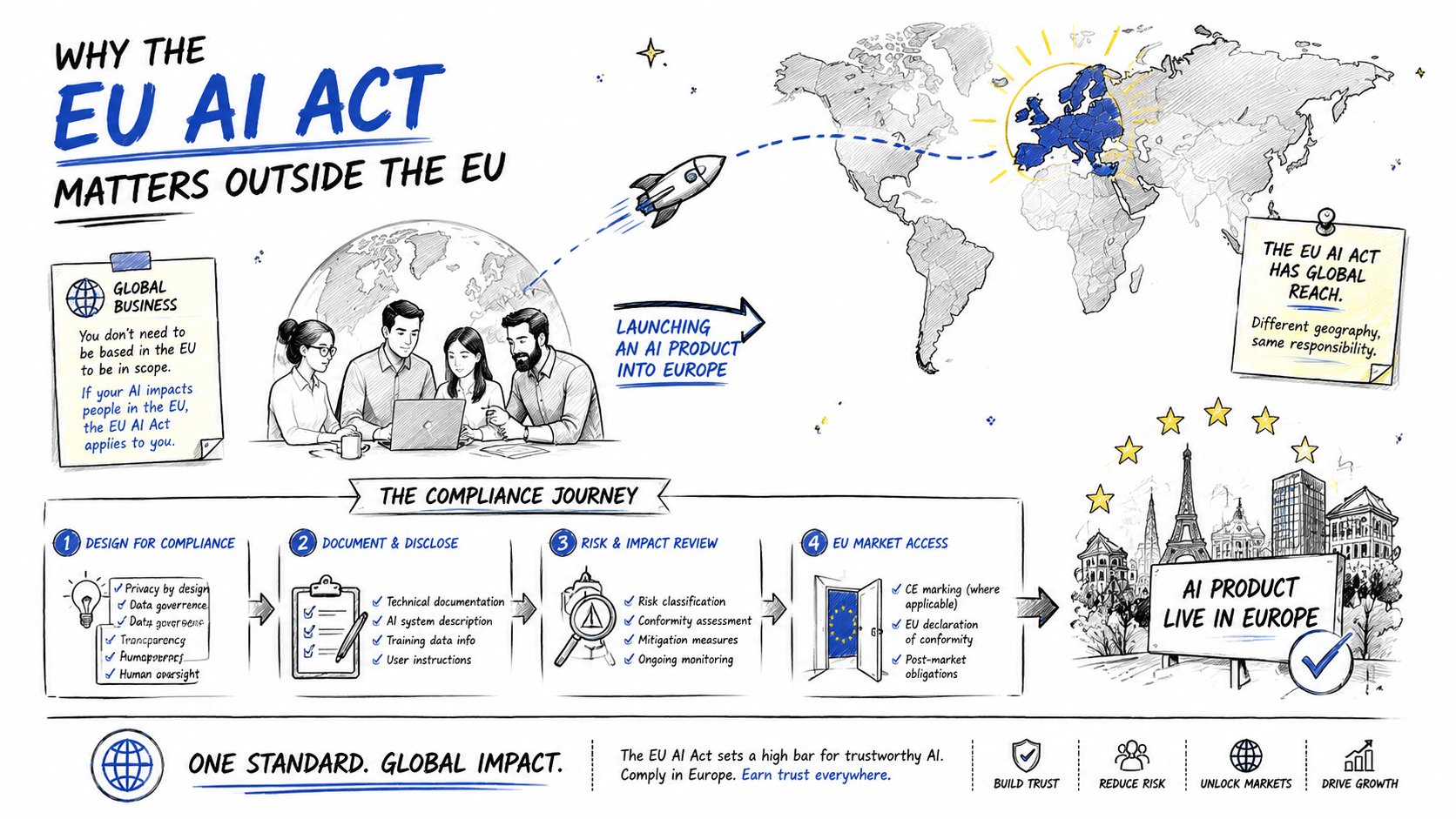
For non-EU providers, the question is not “Do we comply with the EU AI Act?” It’s “Which version of our product can survive EU scrutiny without a redesign?” That mindset is the difference between entering the market cleanly and discovering late that your default model, onboarding flow, or logging practice doesn’t fit the European rules.
Why the EU AI Act Matters Outside the EU
A Singapore-based vendor can have a strong model and still trigger EU obligations the moment it targets EU customers. Territorial reach is the issue. The Act applies to AI systems placed on the EU market, put into service in the EU, and can also reach non-EU providers and deployers where the output produced by the AI system is used in the Union, so your company’s location does not keep you out of scope. If sales is tailoring a pitch for Berlin, legal should already be checking the Act.
The provider is the real unit of analysis
The Act focuses on the provider of the system, not the office address on the incorporation papers. If your company develops an AI system and places it on the EU market, you are in scope even if every engineer sits in California or Tel Aviv. That is why the territorial test matters for non-EU companies, it follows the organization that controls the product, not the one that happens to sit inside the EU.
Practical rule: if you control design, intended purpose, updates, or release into the EU market, assume the Act can reach you.
The regime is broad, not symbolic. It is a full regulatory framework for governance, oversight, and enforcement, and it changes what must be ready before launch. A non-EU provider that starts late usually ends up rewriting product claims, rebuilding evidence, and appointing an EU contact under time pressure.
For non-EU providers handling both data protection and AI obligations, a GDPR compliance services overview can help clarify where the two regimes diverge. EU GDPR Representative can be relevant in parallel where data protection obligations also apply, but do not confuse that with AI Act readiness. The AI Act has its own logic, and your product team needs to treat it as a separate market-access requirement.
Why early work is cheaper
Early classification saves money because it avoids redesign. If product, legal, security, and machine learning teams classify the system early, they can decide whether the feature set needs to change before launch. Once a product is already in the EU pipeline, each late correction turns into a coordination problem across code, documentation, sales language, and external representation.
Understanding the Four Risk Tiers
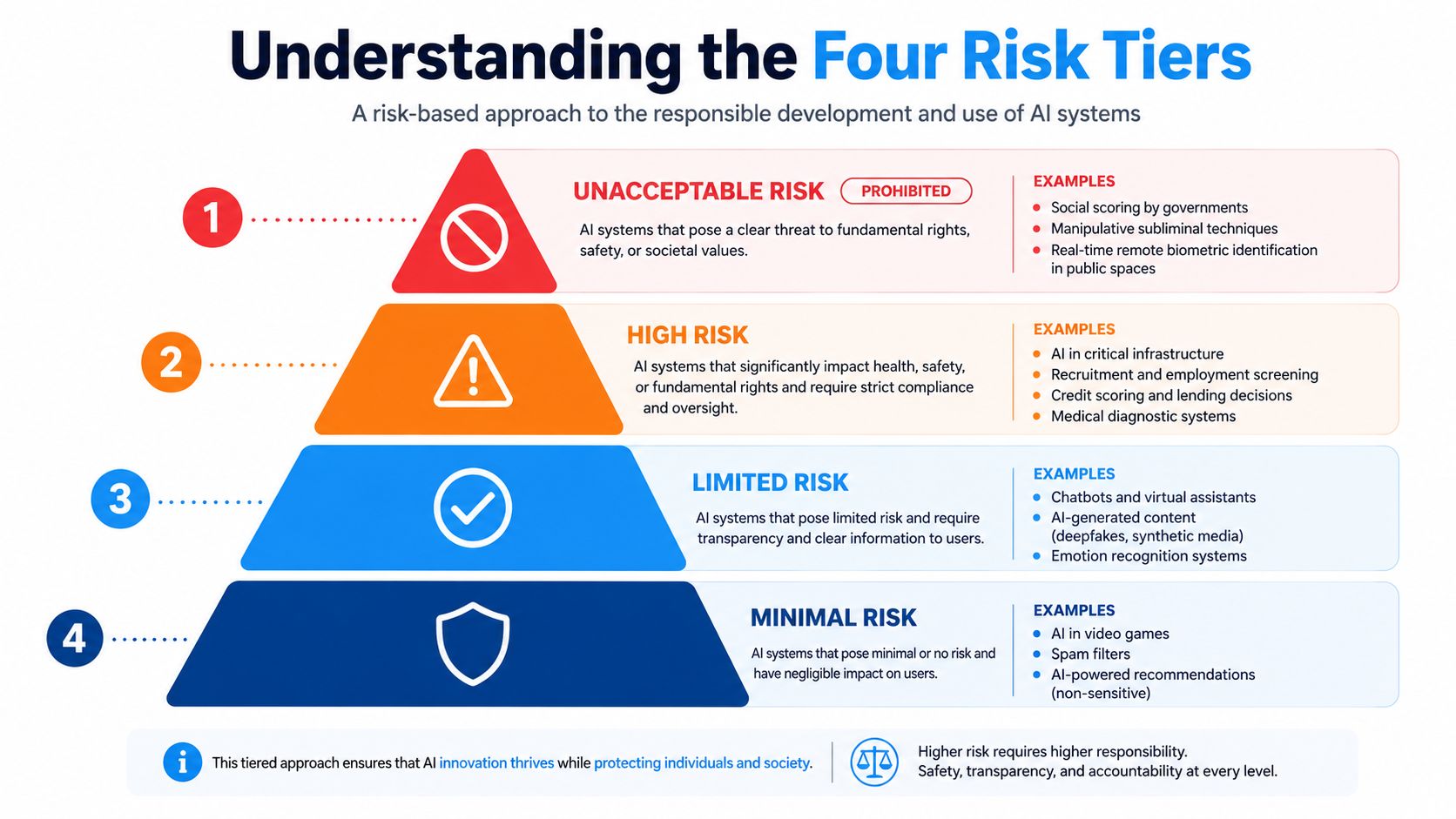
Start with the top of the pyramid, because that is where the red lines are. The EU AI Act treats some practices as unacceptable and bans them outright. Under the verified timeline, those prohibited practices and AI literacy rules became applicable on 2 February 2025, and they are part of the regime that starts tightening before the broader enforcement date in 2026 EU AI Act framework. For a non-EU company, that means a product can be perfectly valid in one market and still be a hard stop in the EU if it crosses one of those lines.
Prohibited practices come first
The prohibited tier is about social scoring, manipulative techniques, untargeted face scraping, and other practices that the EU treats as unacceptable risk. These are not edge cases for legal theory seminars. They are red-line issues that can block a launch entirely. If a product relies on a practice that falls into that category, the right move is not to “document harder.” It is to redesign or remove the feature.
The point of this tier is simple. Some uses are so harmful that the law does not ask whether your internal controls are polished. It just bans them.
High-risk systems need a compliance file, not a policy memo
The next tier is high-risk AI. This includes systems embedded in regulated products like machinery or medical devices, and stand-alone systems used in sensitive areas such as employment, critical infrastructure, and biometric identification. The burden here is much heavier than most non-EU founders expect, because the Act treats these systems as auditable products, not just software features.
The core test is not whether your model is impressive. It’s whether the use case falls into a high-risk category and therefore needs the full compliance package. If it does, the provider carries the heavier obligations.
Limited risk and minimal risk are not free passes
Below that sits the default transparency layer, often described as limited risk. These systems don’t face the same pre-market machinery, but they still trigger user-facing obligations. At the base is minimal risk, where the Act is lightest. That does not mean “ignore it.” It means your product may avoid the strictest requirements, but you still need to verify that the use case really belongs there.
Classification test: ask three questions, is the system prohibited, is it high-risk, or does it fall into the lighter transparency layer? If you can’t answer cleanly, your governance is not ready.
General-purpose AI adds a horizontal layer
The Act also adds a separate layer for general-purpose AI models. That matters because foundation-model governance is not the same as product-specific compliance. A model supplier may face technical testing, documentation, and incident-reporting obligations even before a downstream product team finishes its own deployment assessment EU AI Act model supervision.
The clean way to classify your portfolio is to map each product to one tier, then check whether any feature pushes it upward. Don’t classify by marketing language. Classify by actual function, intended purpose, and foreseeable use.
Choosing Your Conformity Assessment Path
If your system is high-risk, the question becomes procedural fast. You need to know whether you can complete the conformity assessment internally or whether a notified body has to be involved before market entry. That choice depends on what kind of high-risk system you are shipping, and it changes the launch schedule.
Most stand-alone high-risk systems use internal control
For many stand-alone high-risk AI systems, the route is self-assessment. That doesn’t mean lightweight compliance. It means the provider must build the evidence package itself, complete the required checks, and prepare the declaration of conformity. The work is still serious, because the provider has to prove the system fits the rules before placing it on the market.
The assessment sequence should be disciplined. Start with your risk-management process, then validate data and training governance, then assemble the technical documentation, and then verify logging and human-oversight controls. After that, the product can move toward registration in the EU database where required.
Product-safety AI needs third-party scrutiny
The path changes when the AI system is a safety component of a regulated product, such as machinery or medical devices. In those cases, third-party involvement can be mandatory. That means your timeline is no longer controlled only by your own internal review cycle. It also depends on how fast the external conformity process moves.
This is the point where many non-EU teams lose time. They assume they can finish AI compliance in parallel with product certification, then discover the processes are linked and the documentation must line up exactly.
| Provider Type | AI system or model | Authorised Representative Required | Source |
|---|---|---|---|
| Non-EU provider | Certain high-risk AI system | Yes, Article 22 | EUR-Lex official text of Regulation (EU) 2024/1689 |
| Non-EU provider | General-purpose AI (GPAI) model | Generally yes, Article 54 | EUR-Lex official text of Regulation (EU) 2024/1689 |
| Non-EU provider | Qualifying free and open-source GPAI model | Potential Article 54(6) exemption | EUR-Lex official text of Regulation (EU) 2024/1689 |
| Non-EU provider | Other non-high-risk AI system | Not solely on that basis | EUR-Lex official text of Regulation (EU) 2024/1689 |
The conformity route is a product decision. If you get the category wrong, the rest of the file becomes expensive noise.
Make the decision early
Your internal team should decide whether the product is stand-alone high-risk or regulated-product high-risk before the final architecture freeze. Waiting until launch prep is too late. By then, the legal work will be constrained by engineering reality, and the conformity path will be harder to unwind.
For non-EU companies, having a strong EU-facing compliance lead matters. If your assessment says the product is high-risk, don’t treat the conformity step as a paperwork chore. It is the gate that determines whether your product can legally enter the market at all.
Building the Documentation and Quality Stack
The Act’s documentation burden is not abstract. It is a living engineering record that regulators can inspect. If your file is thin, inconsistent, or out of date, you do not have a compliance system. You have a liability stack.
Treat the technical file like a controlled dossier
The technical documentation has to exist before the system is placed on the market, and it has to stay current. That file should describe the system, its design, the intended purpose, and the controls used to keep it within spec. It should also include the evidence behind training, validation, and testing, plus the cybersecurity measures that protect the model and its infrastructure High-risk technical documentation, Article 11 and Annex IV.
If your team cannot produce that dossier quickly, you are not ready. Regulators do not want a slide deck. They want evidence tied to the actual version of the system being sold.
Quality management is a control loop, not a slogan
The quality management system should read like an operational process, not a policy statement. It needs version control, change management, incident handling, post-market monitoring, and a path from field data back to engineering decisions. That is how you show the system stays compliant after release instead of drifting away from the approved configuration.
A useful internal rule is simple.
If a release changes behavior, training data, outputs, or logging, it should trigger a documented review before deployment.
That rule keeps product and compliance teams aligned. It also helps prevent the classic failure where engineering ships a model update and legal never sees the change.
Evidence has to be dated and traceable
Versioned, time-stamped evidence is what protects you when an authority asks how the system was designed and controlled. If your records are scattered across inboxes, shared drives, and one-off approvals, you will struggle to show a coherent compliance story. The Act rewards traceability because it makes enforcement possible.
Keep the stack tight. Document the model lineage, keep records of evaluation runs, and make sure every material update has an owner and an approval trail. That is the difference between a defensible file and a panic exercise when a regulator asks for proof.
Transparency, User Information, and Data Governance
Transparency and data governance should sit in one operating layer. If your users can’t tell they’re interacting with AI, or your datasets are poorly controlled, the system can fail the Act even if the model itself is technically strong. That is a product problem, not just a legal one.
User disclosure has to be visible and immediate
At a minimum, users need to know when they are interacting with an AI system. That means your product design, onboarding flow, and customer-facing language need to say it plainly. The same logic applies to deepfakes and AI-generated content, which need clear marking so users aren’t misled about what they’re seeing.
For general-purpose models, the transparency story also reaches the training side. Providers need to summarise training data in a way that supports user understanding, and they need to respect EU copyright reservations in the datasets they use. If your content and data teams don’t coordinate, you end up with mismatched disclosures that can undermine the entire launch.
Data governance is the technical side of transparency
Good disclosure is impossible without data governance. If the dataset is messy, biased, or poorly documented, the transparency statement becomes a cover story instead of an assurance. That’s why the Act ties data quality, record-keeping, and human oversight together.
The easiest way to handle this is to make the product team own a common evidence layer.
- Inform users clearly: state when the system is AI-based and where that matters in the workflow.
- Control dataset quality: document lineage, filtration, and known limitations.
- Keep records: retain the technical evidence that supports the claims you make to users and regulators.
- Enable human intervention: make sure someone can intervene when the output is unsafe or wrong.
If the user-facing explanation and the engineering record don’t match, assume the audit will expose it.
For companies that also have EU data access and sharing obligations, a EU Data Act representative can sit alongside the AI compliance work where those duties overlap. That does not replace AI Act controls, but it can reduce fragmentation when multiple EU obligations hit the same operating team.
Design choices should make compliance visible
The best teams don’t hide compliance in the legal footer. They build it into the product. Labels, model cards, interface prompts, and internal release gates all help prove that transparency is part of the system, not an afterthought.
A technically elegant model can still fail the Act if the end user is left guessing. That is the standard your product has to meet.
When an Authorised Representative Is Required
A non-EU provider may need an EU AI Act authorised representative through two separate routes: Article 22 for certain high-risk AI systems, and Article 54 for general-purpose AI (GPAI) models.
A non-EU provider has to settle the authorised representative question early. If you place certain high-risk AI systems on the EU market and you are not established in the EU, Article 22 can require an EU-based authorised representative. Separately, if you place a general-purpose AI (GPAI) model on the Union market from outside the EU, Article 54 generally requires an EU-based authorised representative, subject to the applicable free and open-source exception. The obligation sits inside the market-access structure, so treat it as part of launch planning, not a late-stage legal tidy-up.
The mandate is narrow and formal
The representative acts under a written mandate. It must identify the provider, define the scope of the AI systems or models covered, keep contact details current, and require cooperation with national competent authorities and the AI Office. The representative is a contact point and document holder. It is not a substitute compliance department.
That split matters. The provider still owns the obligations. The representative makes them reachable, traceable, and easier to enforce inside the EU.
Don’t confuse this with a consultant
A compliance consultant can advise you. An authorised representative cannot be treated like outsourced legal support. The role is narrower, and the representative can face enforcement consequences tied to the mandate. If the mandate is vague, outdated, or poorly controlled, you have created another weak point.
For a non-EU company, the clean rule is simple. If the system is high-risk, Article 22 may apply. If the system is not high-risk, Article 22 may not apply, but a separate authorised representative requirement may still arise under Article 54 where the provider places a general-purpose AI model on the Union market.
| Provider Type | AI system or model | Authorised Representative Required | Source |
|---|---|---|---|
| Non-EU provider | Certain high-risk AI system | Yes, Article 22 | EUR-Lex official text of Regulation (EU) 2024/1689 |
| Non-EU provider | General-purpose AI (GPAI) model | Generally yes, Article 54 | EUR-Lex official text of Regulation (EU) 2024/1689 |
| Non-EU provider | Qualifying free and open-source GPAI model | Potential Article 54(6) exemption | EUR-Lex official text of Regulation (EU) 2024/1689 |
| Non-EU provider | Other non-high-risk AI system | Not solely on that basis | EUR-Lex official text of Regulation (EU) 2024/1689/oj/eng |
The mandate should be written for inspection, not for convenience. If it cannot survive a regulator’s request, it is not strong enough.
If your company already uses a EU Data Protection Representative, the AI Act appointment may look familiar, but the two roles are not interchangeable. The trigger, scope, and evidence burden are different, so the AI Act mandate must follow the AI Act structure, not a GDPR template.
Where Most Companies Fall Short on Compliance
The biggest gap is execution. EY’s 2025 survey found that 80% of organizations were aware of the EU AI Act, yet only 28% were fully compliant EY AI GRC survey 2025. Awareness is widespread. The weak point is turning that awareness into a live compliance process.
Why that gap matters more for non-EU firms
Non-EU companies usually have weaker EU-specific operating habits. A sales team may be targeting Europe, while no one owns EU documentation, no mandate file is current, and there is no single contact point for authorities. That is the setup that creates friction the moment a request lands.
The Commission has also signaled how it will work. It will start with technical compliance dialogue, model access, information requests, and risk-mitigation demands before moving to sanctions. The first failure is often delay, confusion, or a missed response because nobody can produce the right evidence fast enough AI Office enforcement powers.
What authorities will notice first
Authorities usually spot three weak points first. The company has no clean documentation trail. The EU contact point is unclear. The internal mandate does not match the product placed on the market. Those are not minor gaps. They show the organization has not operationalized compliance.
My view: if your records are not audit-ready, you are not compliant yet, no matter what your policy says.
Fix it with discipline. Assign an EU-facing owner. Lock the product classification. Keep the evidence current. If the company already uses a EU Data Protection Representative, do not treat that as a substitute for the AI Act file. The trigger, scope, and evidence burden are different, and the AI Act mandate has to stand on its own.
What Non-EU Providers Should Do Now
With most EU AI Act provisions now applicable since 2 August 2026, non-EU providers should confirm their product classification, documentation, conformity-assessment pathway and authorised representative requirements now, while also preparing for provisions that apply later. Classify every EU-bound product against the four risk tiers, confirm the conformity path, and scope the technical file now, not after launch. If any high-risk system or GPAI model is involved, assess whether an EU authorised representative is required and make sure the mandate is current and specific.
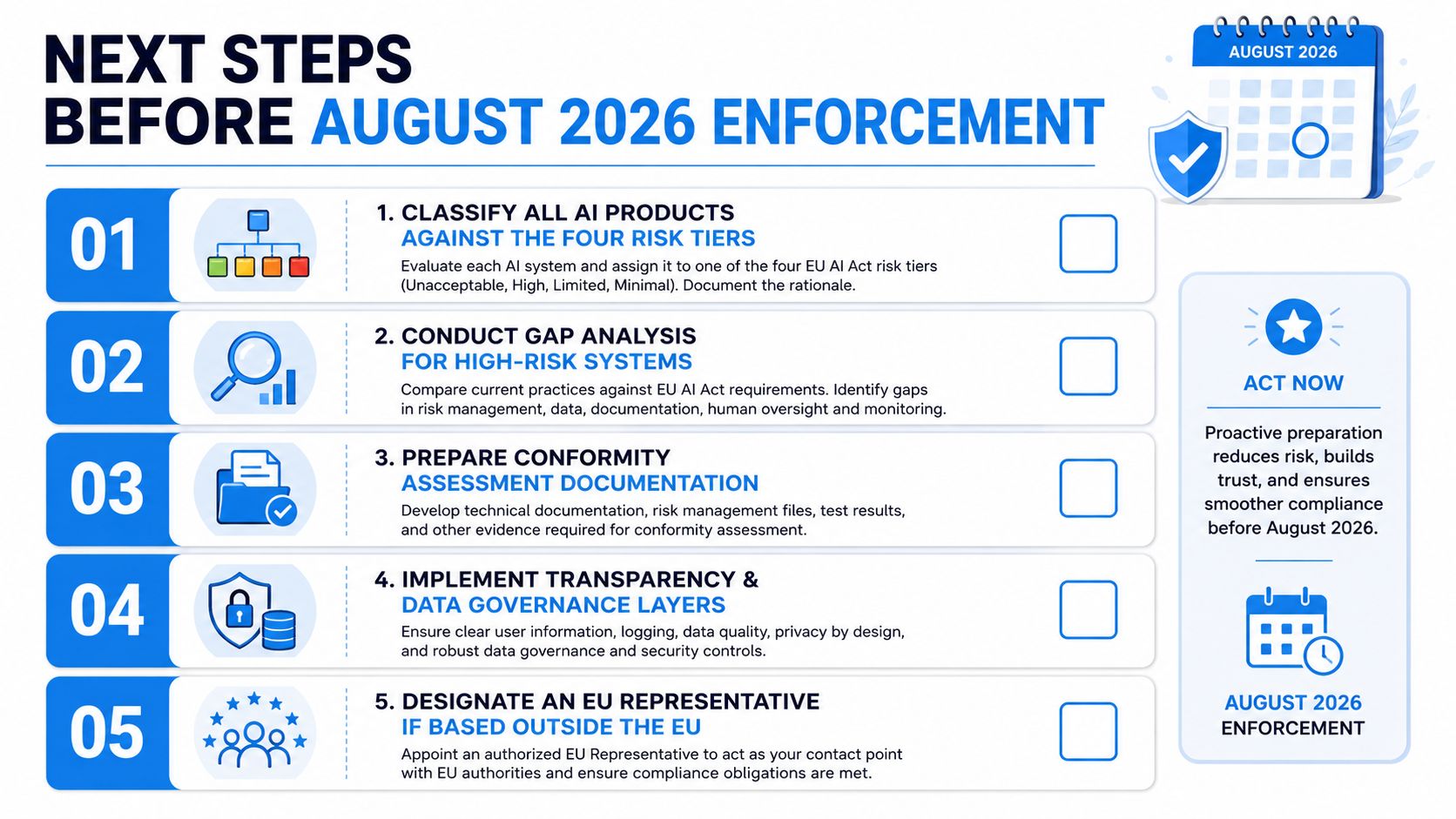
The providers who will handle enforcement smoothly are the ones building versioned evidence, EU-facing contacts, and proactive reporting into the operating model now. Treat the AI Act as an ongoing discipline, not a policy refresh. If you need a structured way to set up representation and keep the contact chain clean across EU obligations, visit DilicheckRep and review how its in-market designation model fits the compliance stack your team is already building.
FAQ: EU AI Act Compliance for Non-EU Providers
Q: Does the EU AI Act apply to companies outside the EU?
A: Yes. The EU AI Act can apply to providers outside the EU if they place an AI system on the EU market, put it into service in the EU, or if the system is used in the EU. Your company does not need an office in Europe to fall within scope.
Q: What is a high-risk AI system under the EU AI Act?
A: A high-risk AI system is one that falls within categories listed by the Act, such as certain systems used in employment, critical infrastructure, biometrics, education, or as safety components in regulated products. High-risk systems face stricter obligations, including documentation, risk management, logging, human oversight, and conformity assessment.
Q: Do non-EU providers need an EU AI Act authorised representative?
A: Yes. A non-EU provider may need to appoint an EU authorised representative when making certain high-risk AI systems available on the EU market under Article 22, or when placing a general-purpose AI (GPAI) model on the Union market under Article 54. Certain qualifying free and open-source GPAI models may be exempt.
Q: When does the EU AI Act apply?
A: The EU AI Act applies in phases. Some provisions, including rules on prohibited practices, began applying in 2025. The main enforcement date for most obligations is 2 August 2026, with some high-risk product rules applying later.
Q: What documentation is required for EU AI Act compliance?
A: For high-risk AI systems, providers typically need technical documentation, a risk-management process, data governance records, logging controls, human-oversight measures, post-market monitoring processes, and a declaration of conformity where required.
Q: What is a conformity assessment under the EU AI Act?
A: A conformity assessment is the process used to show that a high-risk AI system meets the Act’s requirements before it is placed on the EU market. Some stand-alone high-risk systems can follow an internal control process, while AI that is part of regulated products may require third-party assessment.
Q: Can a general-purpose AI model trigger EU AI Act obligations?
A: Yes. General-purpose AI models can trigger a separate layer of obligations under the Act, including documentation, transparency, and, in some cases, additional duties tied to systemic risk.
Q: What is the first step toward EU AI Act compliance?
A: The first step is classification. Providers should determine whether the system is prohibited, high-risk, subject to transparency obligations, or minimal risk. That classification shapes the compliance path, documentation burden, and launch timeline.
DilicheckRep provides formal EU and UK regulatory representation, including GDPR Article 27, EU AI Act, Digital Services Act, Data Act, and NIS2 contact-point services, with mandate documentation and structured handling of authority and data subject communications. Review your representation scope and operating model with DilicheckRep before your next EU market launch.
Disclaimer: This guide is provided for general information purposes only and does not constitute legal advice. The application of EU data protection and other regulatory requirements depends on the specific circumstances of each organisation. You should obtain appropriate legal advice where necessary before relying on this information or making compliance decisions.
Disclosure: This article was prepared with AI assistance and human review.