You’re already dealing with the hard part. The company sells into the EU, the UK, or both, the legal team wants a clean answer on Article 27, the privacy lead wants a DPO who can do the job, and procurement is staring at vendor decks that blur representation, advisory, audit, and software into one vague “GDPR solution.” That’s the trap. GDPR compliance services are not one category, and buying them that way is how teams miss gaps, overbuy tooling, and end up with coverage that looks fine in a slide deck but fails under regulator scrutiny.
Here’s the right way to think about it. Representation creates the in-market legal contact point. DPO outsourcing gives you independent privacy leadership. Audits tell you what’s broken. SaaS platforms keep the routine work from falling apart. The winning stack is usually a composition of those models, not a choice between them.
| Archetype | What it really does | What it does not do | Best use case |
|---|---|---|---|
| Regulatory representation | Creates a mandated EU or UK contact point for authorities and data subjects | It does not become your privacy team or run your remediation programme | Non-EU or non-UK firms that need an in-market representative |
| Outsourced DPO | Provides independent advice, monitoring, and regulatory interface | It does not automatically maintain your records or fix process drift | Companies that need Article 37 to 39 coverage without hiring in-house |
| Compliance audit | Tests readiness, gaps, and evidence quality | It does not keep the programme alive after the report is delivered | Post-incident review, board assurance, or pre-regulator validation |
| SaaS compliance platform | Automates workflows like consent, ROPA, DPIA, and vendor tracking | It does not replace legal accountability or act as your mandated representative | Teams with enough maturity to operationalise compliance at scale |
If you are trying to decide which vendor to buy, don’t ask which model is “best.” Ask which obligations you already carry, which ones need a legal actor, and which ones need continuous operational support.
Why Multinational Buyers Need a Clear Compliance Stack
A multinational buyer rarely starts with a clean slate. A sales team is pushing into France, Germany, and the Netherlands, the UK unit keeps raising privacy questions, and marketing keeps adding new tools faster than legal can review them. Then a board member asks why the EU AI Act, the Digital Services Act, the EU Data Act, and NIS2 are sitting in the same procurement discussion as GDPR. The answer is plain. The obligation surface is expanding, but vendors still sell privacy services as if one model fits every problem.
The first mistake is treating every privacy service as a consulting layer. That works for a one-off assessment, but it fails when the business needs a named contact point, a live record of processing, and an escalation path that survives turnover. The second mistake is assuming software can carry accountability. It can organise evidence, but it cannot be the mandated representative or independent DPO where the law requires an actual role-holder.
The practical buyer problem
Global companies are not trying to buy “GDPR compliance” in the abstract. They are trying to assemble a stack that can support cross-border operations, local authority contact, and recurring evidence requests. The buying question is simple, which layer solves which obligation, and which layer is still missing?
For non-EU businesses, Article 27 representation is often the first structural requirement to settle. The GDPR requires a representative in the Union for many foreign controllers and processors, and that representative must be reachable by supervisory authorities and data subjects on all issues related to processing, as stated in Article 27 of the GDPR. That is a formal obligation, not a courtesy mailbox.
Larger organisations need more than that. A DPO function covers governance and independence. Audits expose the weak spots. SaaS platforms keep records, requests, and workflows from drifting. Use one layer as a substitute for the others, and the coverage gaps will only surface when an inquiry lands.
A clear compliance stack avoids that failure. It separates the legal role, the advisory role, the diagnostic layer, and the operational tooling. Each one solves a different problem. Buyers who blur them end up paying for the wrong promise and still carrying the missing obligation.
The Four Service Archetypes Explained
Buyers keep getting sold “GDPR compliance” as if it were one service. It is not. The market splits into four different service models, each with a different job, a different contract shape, and a different failure mode. If you do not separate them, you will compare the wrong offers and miss the gap in your compliance stack.
Regulatory representation is a legal contact role
Regulatory representation exists for organisations that need a formal in-market legal interface in the EU or UK. For many non-EU controllers and processors, Article 27 requires a representative in the Union who can be contacted by supervisory authorities and data subjects on processing matters, as set out in Article 27. That is a legal appointment, with a defined mandate and clear records, and it sits far outside ordinary consulting.
The service also matters for global operators dealing with related privacy regimes, but the core function does not change. A representative receives formal communications, routes them properly, and keeps the mandate visible to the regulator. It is a role-holder, not advice on demand.
Outsourced DPO support is governance in practice
DPO outsourcing covers independence, monitoring, advice, and the regulatory interface. The DPO sits inside the organisation’s accountability structure, so the outsourced service has to preserve that independence and define the actual duties clearly. Privacy support alone does not meet the mark.
The weak versions are easy to spot. Vendors sell a “DPO package” that is really just generic privacy consulting with a retainer on top. If the agreement does not spell out decision boundaries, escalation paths, and how regulatory contact will work, the buyer has purchased advice, not a DPO function.
Audits and SaaS platforms solve different problems
A compliance audit is a diagnostic exercise. It tests evidence, process maturity, and gaps, which makes it useful when a business needs independent validation or a remediation roadmap. It does not run the programme day to day.
A SaaS compliance platform is the operational layer. It handles consent, records of processing, DPIA workflows, vendor risk, and similar recurring tasks. Independent benchmarking for GDPR tooling makes the distinction plain, because the GDPRbench framework evaluates correctness against GDPR workloads, response time to GDPR queries, and storage-space overhead. That is the right lens for software. Judge the platform on whether it performs the workload correctly and efficiently, not on how polished the interface looks.
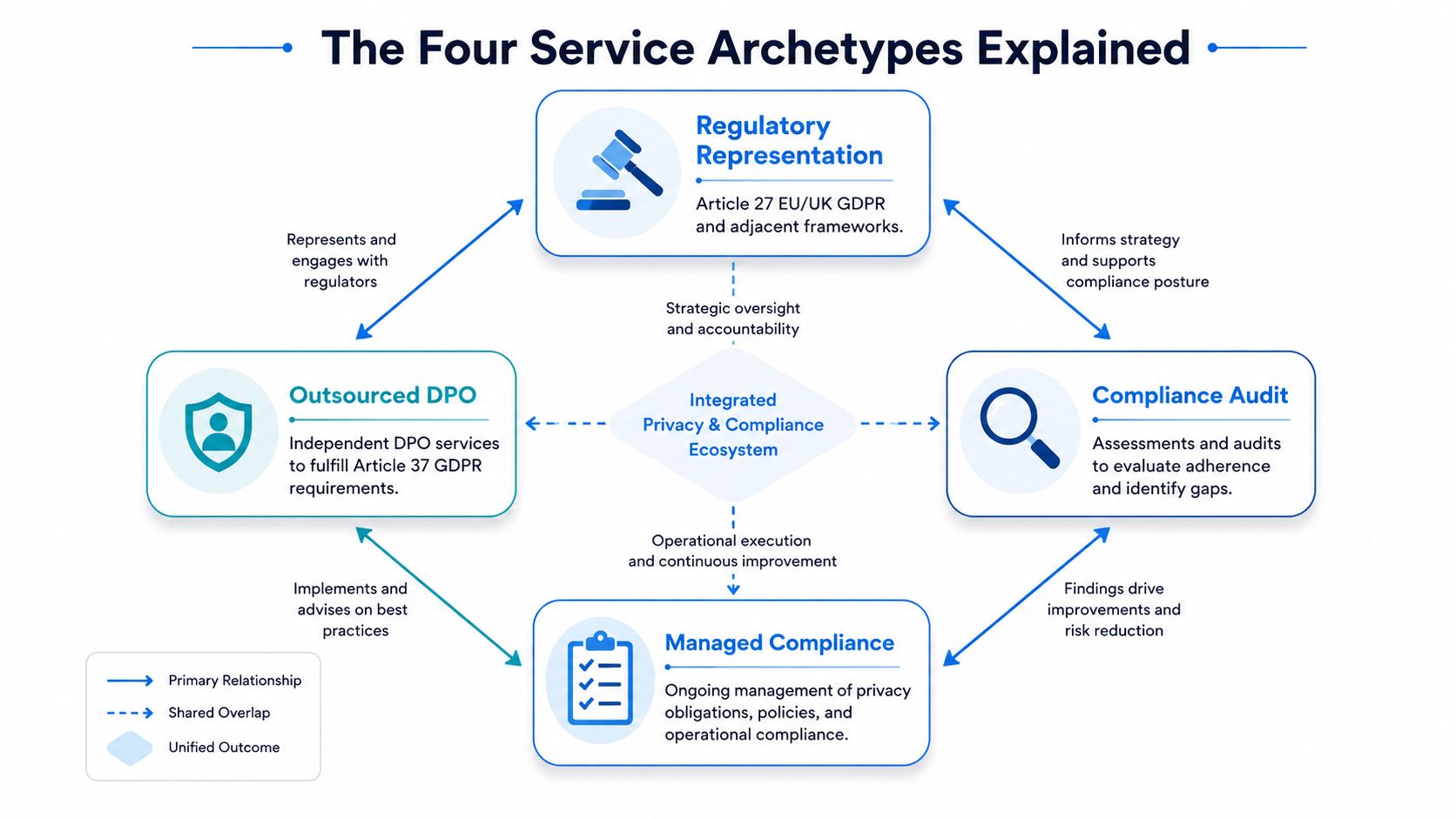
The practical takeaway is straightforward. Representation creates a legal actor. DPO outsourcing creates governance capacity. Audits create evidence. SaaS creates continuity. Most businesses need at least two of these, and many need all four working together.
Enforcement Reality That Drives the Buying Decision
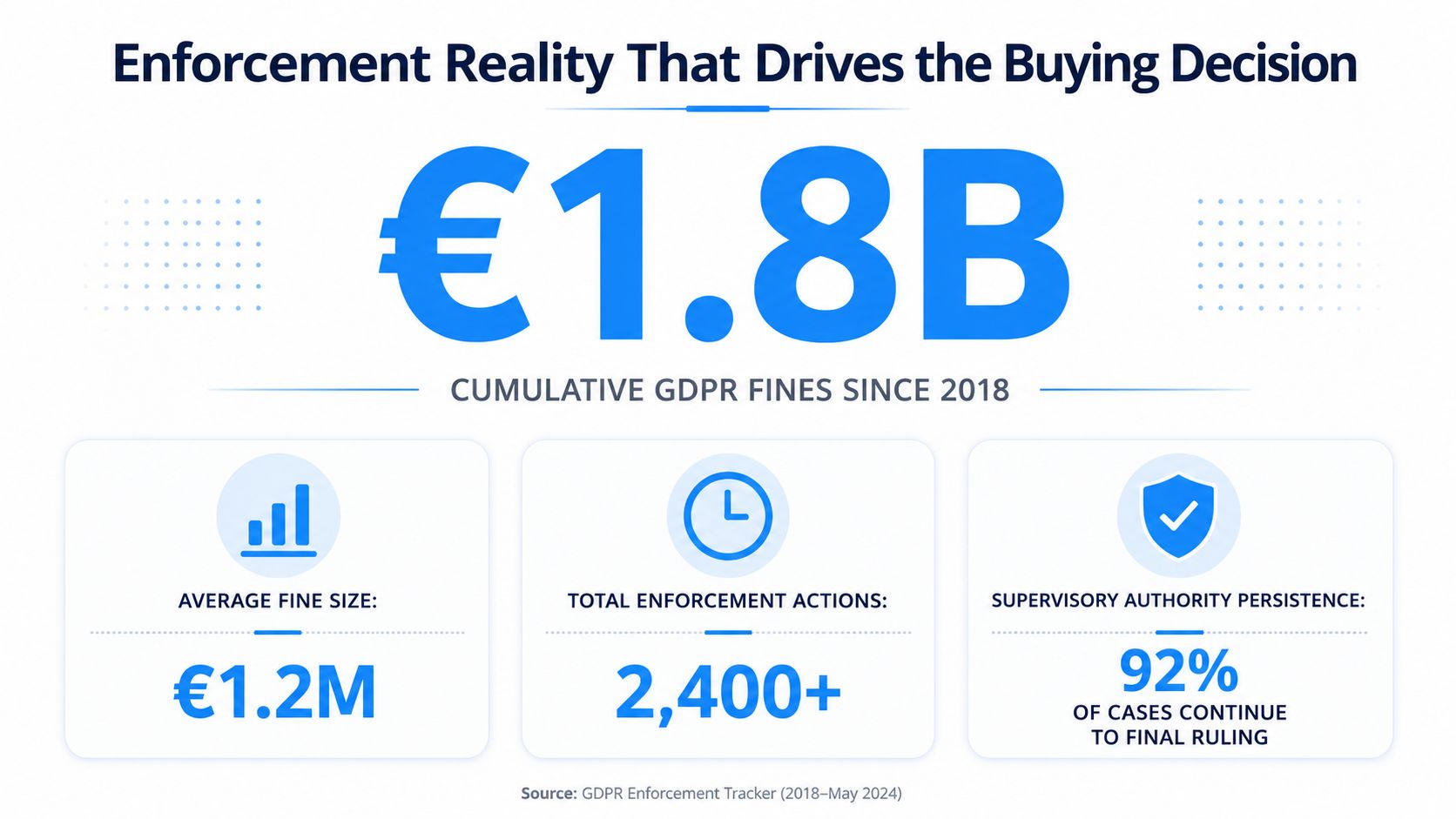
A multinational that treats GDPR enforcement as background noise is already behind. Regulators have made clear that weak operating models get tested. The CMS GDPR Enforcement Tracker recorded 2,086 fines by 1 March 2024, up by 510 from the prior year, with those recorded fines totaling about EUR 4.48 billion. By 1 March 2026, the same tracker had grown to 2,685 fines totaling around EUR 6.11 billion. The average fine across the 2018 to 2024 period was about EUR 2.14 million. See the CMS enforcement tracker numbers and figures for the underlying reporting.
Why this changes procurement
Those figures change procurement in a simple way. A compliance programme is ongoing operations, not a one-time legal tidy-up. It has to stand up across jurisdictions, keep pace with regulator contact, and preserve a clean evidence trail.
That is why foreign controllers and processors should stop treating Article 27 representation as optional admin. The representative is the formal contact point. If that contact point does not exist before questions start, the business is exposed from day one.
The market is also moving away from annual consulting as the default answer. Buyers now want a service that can absorb an inquiry, route communications quickly, and keep records intact under pressure. If the vendor cannot do that, polished policy templates do not matter.
Tooling is being judged on operational performance
The same pressure applies to software. Buyers are done with feature grids that look good in sales decks. They want proof that the platform handles real GDPR workloads correctly, responds fast enough, and does not waste storage or break production systems.
That is why the GDPRbench framework matters. It evaluates correctness, response time to GDPR queries, and storage-space overhead. That is the right standard for software. Judge the platform on whether it performs the workload cleanly and efficiently.
Enforcement now punishes weak operations, not just weak documentation. If your representative, DPO, and platform cannot work together during a regulator request, the programme is too fragile.
The implication is blunt. GDPR compliance services now belong in business continuity planning. Pay for the vendors that keep you contactable, auditable, and responsive when the regulator shows up.
Side by Side Comparison of the Four Archetypes
The fastest way to stop bad procurement is to compare the four archetypes on what they do, who legally acts, and where they fit. That sounds basic, but most vendor decks avoid those questions because the answers expose the boundaries of the service.
| Archetype | Primary Deliverable | Legal Actor | Best-Fit Company Profile |
|---|---|---|---|
| Regulatory representation | Formal EU or UK contact point, routed communications, mandate records | The representative acts on behalf of the client for the designated contact function | Non-EU or non-UK firms selling into the EU or UK, and needing a mandated local interface |
| Outsourced DPO | Privacy oversight, advice, monitoring, authority interface, policy input | The DPO function acts within governance, but the client remains accountable | Mid-market and enterprise teams that need independent privacy leadership |
| Compliance audit | Gap analysis, readiness assessment, remediation findings, evidence review | The auditor acts independently and reports back to the client | Companies that need validation before a board review, merger, or regulatory interaction |
| SaaS compliance platform | Automated records, workflows, and evidence trails | The client acts through the platform, the vendor supplies tooling | Teams with internal ownership that need scale and repeatability |
Regulatory representation is the only model here that creates a formal external actor in the jurisdiction on the client’s behalf. That’s the point many vendors try to blur. If a service says it covers “representation,” but the contract doesn’t clearly establish a mandate, it’s not the same thing as an Article 27 appointment.
Outsourced DPO is different. It can be a very strong choice, but it cannot replace a representative where one is required, and it cannot act as your audit function. Its strength is governance and independence, not operational automation.
Audits are useful when you need truth, not comfort. The weakness is obvious. Once the report is delivered, nothing moves unless someone owns the remediation work. That’s why audits are usually additive, not standalone.
SaaS platforms are the workhorses. They help teams maintain records and run workflows, but they don’t solve legal accountability on their own. A platform can store the facts. It can’t be the role that the law requires.
Matching Service Types to Multinational Scenarios
The right stack depends on where the company is in its operating life, not on whether it likes consultants, software, or retainers. A non-EU SaaS startup, a scaling multinational, and a post-incident enterprise do not need the same mix. They need the same four archetypes in different proportions.
A non-EU SaaS company launching in the EU and UK
For a first launch, representation is mandatory where Article 27 applies, because the business needs a formal contact point in market. DPO outsourcing may be useful if the company lacks in-house privacy leadership. SaaS tooling becomes important if the product handles consent, DSARs, vendor tracking, or processing records from day one. A full audit is usually optional unless the business is preparing for a large enterprise customer or a high-friction market entry.
The mistake here is trying to “wait and see” on representation. That creates avoidable friction before the first meaningful data request even arrives.
A growing company selling into multiple member states
This is the classic mid-market problem. Internal privacy resource exists, but it’s stretched thin and doesn’t have an in-market contact point everywhere. In that scenario, representation is the structural requirement, outsourced DPO is often the best way to add continuity, and platform tooling keeps the recurring workload from burying the team.
If the company also needs to align GDPR with other frameworks, consolidation matters. One channel for GDPR, AI Act, DSA, Data Act, and NIS2 communications is easier to govern than five separate external contacts. If that sounds operationally boring, good. Boring is cheaper than fragmented escalation.
A post-incident organisation
After a breach or authority inquiry, the first need is an audit or readiness assessment. That gives management a factual baseline. Representation is required if the organisation lacks a local contact in scope, and a DPO function should be in place to coordinate the response. SaaS tooling helps only if it can produce clean evidence and preserve the logs the incident team needs.
For organisations in this phase, compliance is no longer a policy exercise. It is remediation, evidence control, and communication discipline.
EU GDPR Article 27 representative service
If you need a formal EU contact model that routes supervisory and data subject communications into one structured channel, review DilicheckRep. It sits in the representation layer, not the consulting layer, which is exactly why it belongs in this part of the stack.
Pricing Models and What Each Price Band Buys
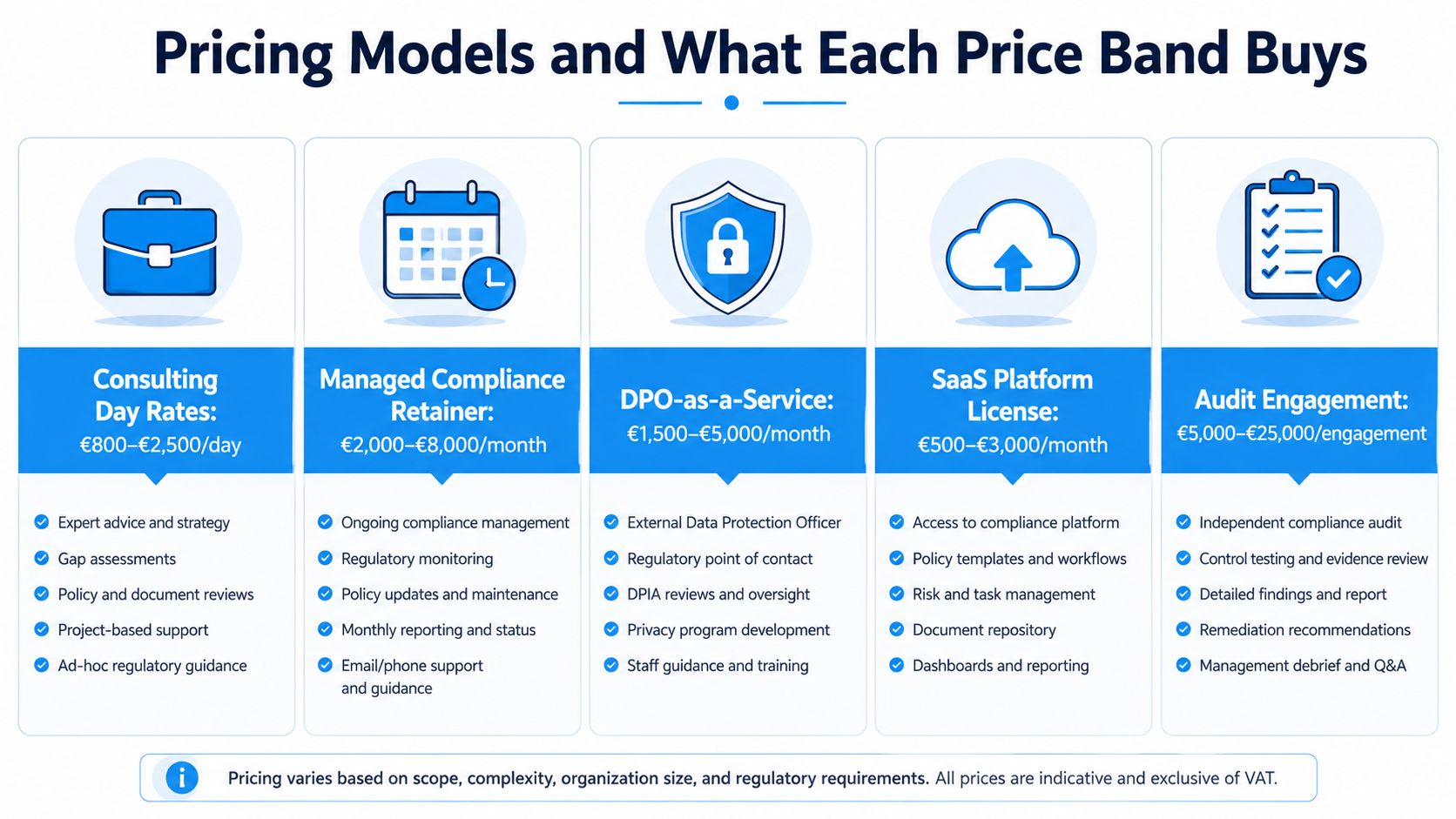
Published pricing tells you more about the service model than the sales page does. The 2026 market comparison shows consulting at roughly €500 to €3,000 per day, managed compliance at €1,000 to €25,000 per month, DPO-as-a-Service at €300 to €15,000 per month, software platforms at €50 to €25,000 per month, and audits at €3,000 to €100,000 per engagement. The same source notes that SMBs commonly spend €500 to €3,000 per month on a combined software and outsourced DPO stack, while mid-market organisations typically spend €30,000 to €80,000 annually on a structured programme. Those ranges come from UnderDefense’s 2026 comparison.
What the price usually signals
A daily consulting rate buys expertise and project intensity. It doesn’t buy continuity unless the engagement is explicitly structured that way. A managed compliance retainer buys ongoing operational coverage, but you still need to check whether that includes actual mandate handling or only advisory availability. DPO-as-a-Service should buy the independence and regulatory interface a real DPO function requires. Software subscriptions buy repetition, recordkeeping, and workflow automation. Audit fees buy independent assessment, not remediation.
The biggest procurement error is scope confusion. Teams pay retainer prices for a service that only offers scheduled calls, or they pay audit-level prices for work that could have been handled by a platform plus a smaller advisory layer. That’s waste.
Under-scoped and over-scoped engagements
Under-scoped engagements are common in representation and DPO buying. A vendor may offer a “package” that sounds formal, but the actual mandate language is too vague to survive scrutiny. Over-scoped engagements are just as bad. You sometimes see full audit spend being used to produce findings that could have been identified faster with a platform and a narrower review.
Rule of thumb: cost per month tells you the model. Cost per mandate tells you the scope.
If you’re an SMB, the combined software plus outsourced DPO stack is usually the cleanest starting point. If you’re mid-market, the annual spend should reflect continuous coverage, not periodic rescue work. If you’re enterprise, you should expect layered services, not a single invoice that pretends one model covers every obligation.
Vendor Evaluation Criteria That Actually Matter
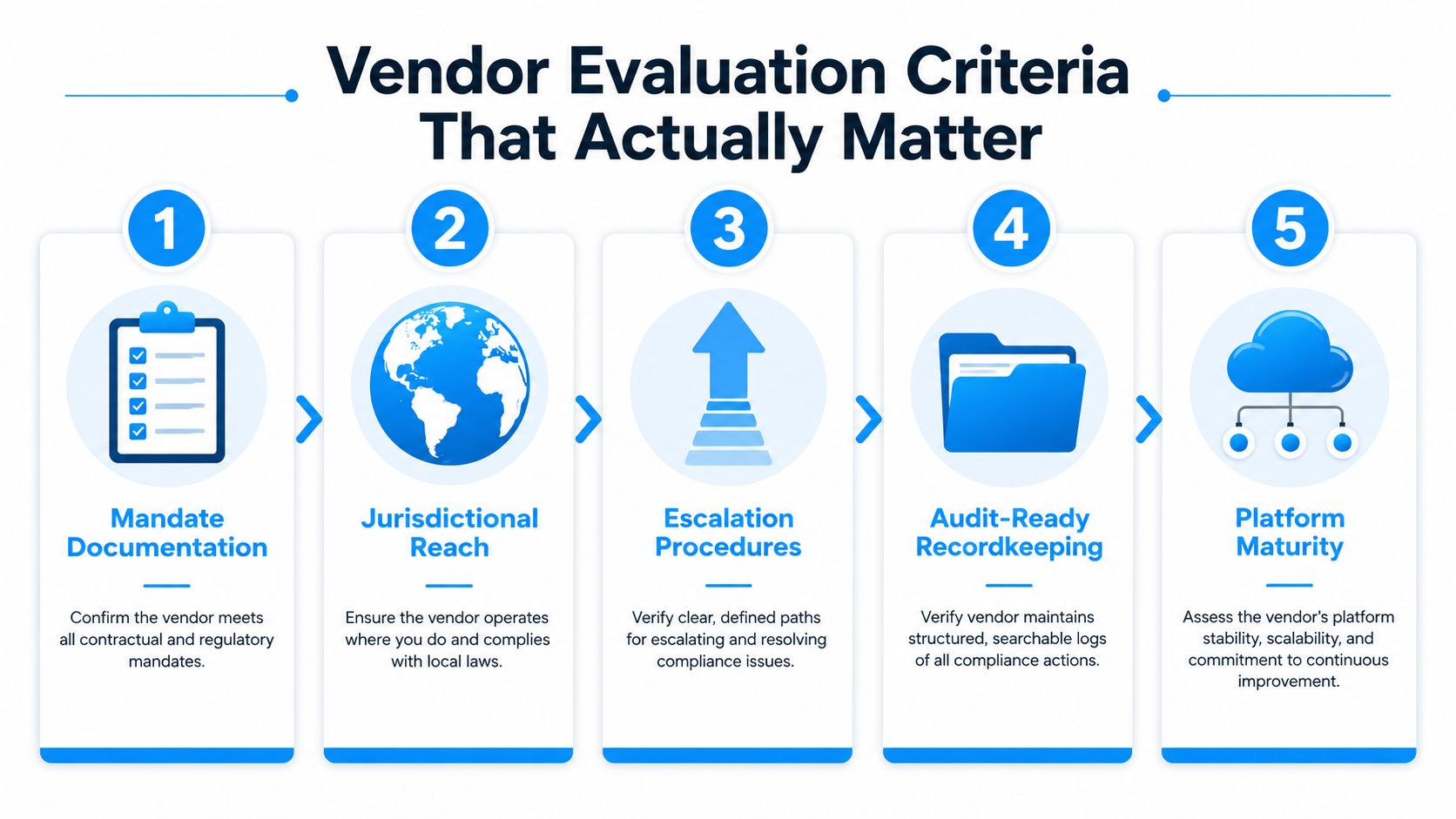
Procurement teams love feature grids because feature grids are easy to score. They’re also the wrong tool for this job. You should be asking whether the vendor can prove mandate scope, jurisdictional reach, escalation discipline, and audit-ready logs. Anything less is theatre.
The seven checks I would not waive
- Written mandate scope. If the service is representation, the mandate needs to say so plainly. If it’s DPO support, the independence and responsibilities need to be explicit.
- Named EU or UK operational presence. Representation without a real jurisdictional footprint is weak on day one and unusable on day two.
- Documented intake and forwarding procedures. Authorities and data subjects need a reliable channel, not a shared inbox that only one employee monitors.
- Multi-framework consolidation evidence. If the company is juggling GDPR with AI Act, DSA, Data Act, or NIS2 obligations, the vendor should show how those channels are handled.
- Time-stamped request logging. If it’s not logged, it won’t be defensible later.
- Clear separation between representation and consultancy. A vendor that blurs those lines is already telling you the contract will be messy.
- Subscription terms that reflect continuous coverage. If the service is meant to be ongoing, the commercial model should look like an ongoing obligation.
That list matters because regulators don’t care how polished the pitch is. They care whether the right role existed, whether communications were routed correctly, and whether the company can show what happened.
The most common procurement failure is buying a marketing-led “EU representative” package that can’t survive regulator scrutiny because the mandate, the forwarding process, and the logging trail are all vague.
If you want a practical reference point for how a formal representation mandate should be framed, review DilicheckRep and check whether the document separates representation from consultancy in a way your legal team can defend.
Building Your Compliance Stack and Final Recommendations
For non-EU and non-UK commercial sellers, the base layer is regulatory representation wherever required, plus SaaS tooling for operational discipline. Add DPO outsourcing when the privacy function is too thin to handle governance well. For AI providers placing systems on the EU market under the AI Act, representation and DPO support become harder to ignore, because the communications and accountability channels need to be live before scrutiny starts. For digital service providers under the DSA, unified representation across frameworks makes more sense than separate appointments. For connected products and data infrastructure operators under the EU Data Act and NIS2, consolidation is the procurement win, because multiple obligations need one disciplined contact path.
If you want a programme that scales, don’t buy isolated services. Build a stack. DilicheckRep is an example of the kind of consolidated representation model that fits multinational operations better than one-off appointments.
If your company is trying to cover EU or UK representation, DPO outsourcing, and multi-framework escalation without fragmenting the stack, Dilicheck Rep is built for that operating problem. It provides formal in-market regulatory representation and structured handling of supervisory and data subject communications, which is exactly where many multinational programmes break down.
Dilicheck Rep provides formal EU and UK regulatory representation, including GDPR Article 27, EU AI Act, Digital Services Act, Data Act, and NIS2 contact-point services, with mandate documentation and structured handling of authority and data subject communications. Review your representation scope and operating model with Dilicheck Rep before your next EU market launch.
Disclaimer: This guide is provided for general information purposes only and does not constitute legal advice. The application of EU data protection and other regulatory requirements depends on the specific circumstances of each organisation. You should obtain appropriate legal advice where necessary before relying on this information or making compliance decisions.
Last updated: August 2026
Disclosure: This article was prepared by compliance expert with AI assistance.