
A product lead at an Indian SaaS company opens the compliance roadmap and sees 13 May 2027 circled in red. The date isn’t when the Digital Personal Data Protection framework becomes a policy topic. It is the point at which the company must show that notices, consent, rights handling, security safeguards, retention, vendor controls, and breach processes work in production.
That creates a practical problem. Privacy teams need engineering capacity, procurement needs time to renegotiate processor contracts, security teams need evidence, and product teams may need to rebuild consent and withdrawal flows. Companies serving European customers also need to align this work with existing EU and UK obligations, rather than create another disconnected compliance programme.
The right question isn’t whether your organisation has a DPDP policy. It is whether the organisation can trace personal data from collection to deletion, prove why it processes that data, respond to a Data Principal request, reconstruct an incident, and demonstrate that suppliers follow equivalent safeguards. That is what Indian companies should be doing before the May 2027 DPDP deadline.
Why the May 2027 DPDP Deadline Is Already a Present Problem
The deadline is fixed, and the preparation window is finite. Multiple legal trackers and industry briefings place the full substantive DPDP compliance date at 13 May 2027, exactly 18 months after the DPDP Rules were notified on 13 November 2025 (timeline and deadline analysis). Treating May 2027 as the month to begin work confuses the enforcement gate with the delivery date.
By then, your company must have operational controls for notice and consent handling, breach reporting, reasonable security safeguards, children’s data controls, rights handling, and cross-border transfers. Those controls depend on systems, contracts, owners, testing, and evidence. A privacy notice drafted near the deadline won’t repair an application that has no reliable consent receipt, or a vendor register that can’t identify where customer data flows.
Convert the date into dependencies
Leadership should translate the deadline into delivery workstreams immediately:
- Product engineering: Build or modify collection, consent, withdrawal, preference, and rights interfaces.
- Data governance: Complete the data-flow inventory, purpose records, retention logic, and deletion triggers.
- Security: Demonstrate encryption, access governance, monitoring, incident response, and log retention.
- Procurement: Review processor agreements and require equivalent safeguards from relevant vendors.
- Legal and compliance: Align notices, contracts, cross-border arrangements, grievance procedures, and accountability records.
- Executive governance: Assign accountable owners and review unresolved risks as delivery blockers, not administrative observations.
The 18-month implementation window was intended to help organisations move from policy drafting to operational readiness, but engineering and vendor remediation consume that time (regulatory alert on phased enforcement). Teams that wait until the first quarter of 2027 will have little room for failed testing, supplier delays, revised data protection impact assessments, or consent architecture changes.
Practical rule: If a control can’t produce evidence from a real system, it isn’t ready for enforcement.
Start with an executive inventory of every system, vendor, customer journey, and business process that handles personal data. Then ask one question for each item: what must change, who owns the change, and what evidence will prove completion? That exercise turns a distant date into a governed delivery plan.
The Three Milestones Behind a Single Deadline
DPDP readiness follows a phased timetable, but companies should run it as one engineering and governance programme. The Rules were notified in November 2025. Some provisions applied immediately, another tranche begins after 12 months, and the final substantive obligations reach the 18-month mark in May 2027. The staggered model creates three delivery gates, each requiring a defined owner, test plan, and evidence trail. The effective sections and deadlines guide sets out the relevant sections and timing.
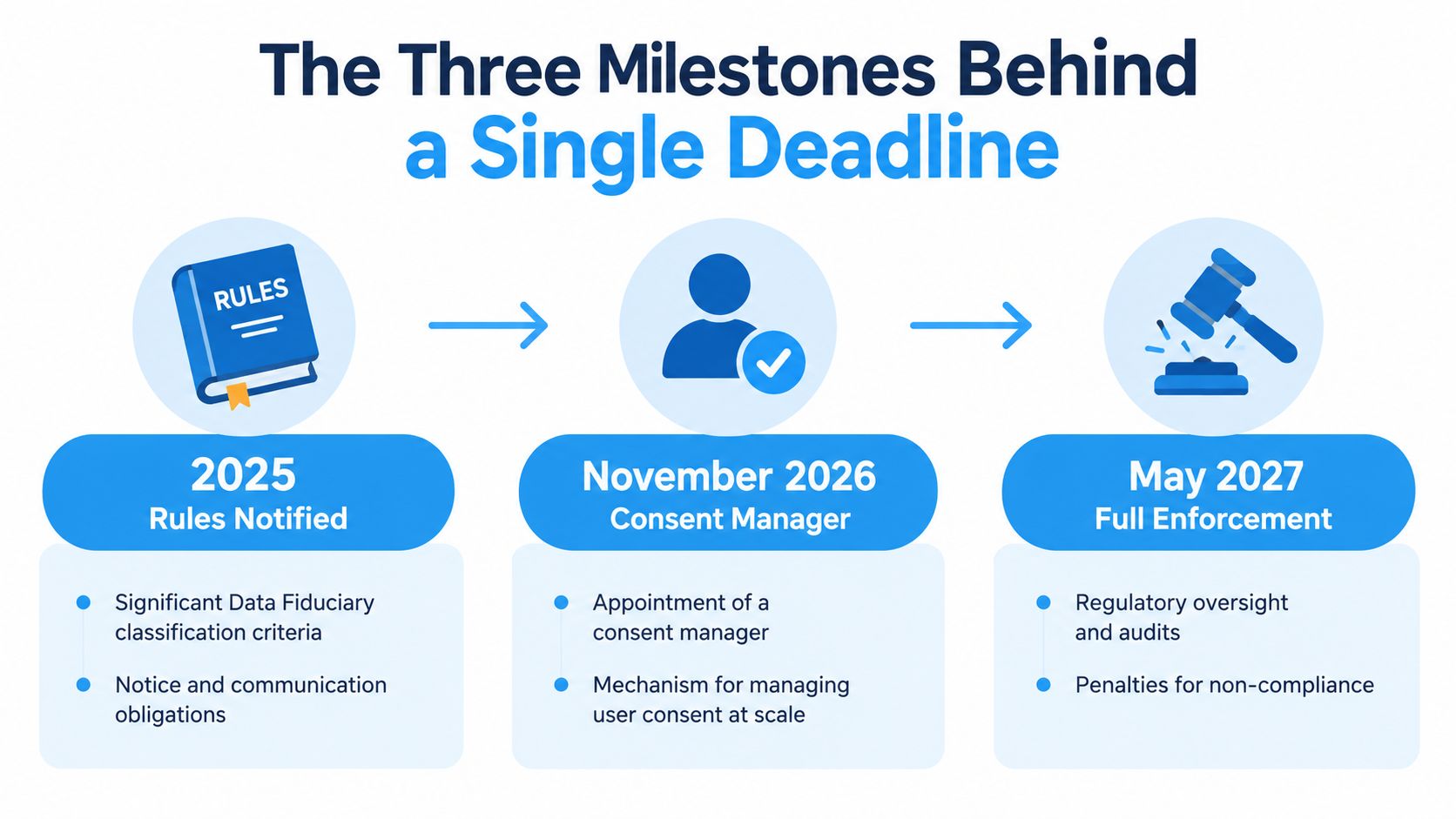
Gate one, the notified Rules
Start with classification, applicability, and the provisions already in force. Determine whether the organisation could fall within Significant Data Fiduciary expectations, then establish the governance needed for notices, processing records, supplier oversight, and accountability.
Classification changes the delivery plan. It affects governance design, assessment work, reporting expectations, and the evidence leadership should require from privacy and security teams. Treat this gate as an active workstream, not a legal memo.
Gate two, the November 2026 Consent Manager milestone
The most consequential upcoming date is 13 November 2026, when the Consent Manager registration milestone begins under the staggered regime. Consumer products, ad-tech platforms, SaaS providers, and e-commerce businesses should settle their consent architecture before then.
Decide whether consent will be managed directly or through a registered intermediary. Review vendor contracts, test SDK and API integrations, and verify that withdrawal and grievance workflows preserve a defensible audit trail. This decision also affects systems serving EU and UK users, so teams should avoid building an India-only consent path that later requires costly redesign.
Gate three, full substantive compliance
The 13 May 2027 gate covers the core operational obligations. By then, the organisation must show that its operating model works across production systems, with evidence that supports review and remediation.
Plan backward from each gate. November 2026 should confirm the consent architecture. May 2027 should confirm the complete operating model, including its governance, technology, and cross-border compliance dependencies.
Building the Security Safeguards That Survive an Audit
DPDP security readiness belongs in the engineering backlog and the internal audit plan. The 2025 Rules require reasonable safeguards that include encryption in transit and at rest, strict access controls, masking or anonymisation where appropriate, monitoring of access and processing activity, one-year log retention, incident-response procedures, and equivalent safeguards in processor contracts (DPDP security safeguards guide).
A privacy policy can describe these controls, but it can’t substitute for them. An auditor, customer, regulator, or internal investigation will look for configuration records, access histories, incident artefacts, supplier assessments, and change evidence.
Build the control stack
Start with encryption and key management. Document which repositories contain personal data, how encryption is enabled, who can access keys, how access is reviewed, and what happens when a key or credential is rotated. Avoid treating a cloud-provider default as the complete control description. Your evidence should connect the setting to the relevant processing activity.
Access control needs the same discipline. Use role-based permissions, remove dormant accounts, separate administrative privileges, and record periodic least-privilege reviews. The control owner should be named, the review output should be stored, and exceptions should have an expiry or remediation decision.
Logging is where many programmes become unverifiable. Centralise access and processing records, protect them against unauthorised alteration, and confirm that retention works for the required period. Security teams should link log sources to the systems recorded in the data inventory, so an incident responder can identify the relevant evidence without starting a manual search across every environment.
Make evidence ownership explicit
Assign evidence ownership to the people who operate each control:
- Security engineering: encryption configuration, key management, vulnerability remediation, and security monitoring.
- Identity and access management: role reviews, privileged access records, and joiner-mover-leaver controls.
- Platform engineering: backups, restoration tests, log pipelines, and retention settings.
- Procurement and vendor risk: processor assessments, contract clauses, and remediation tracking.
- Privacy governance: control mapping, exceptions, and links between safeguards and processing purposes.
Audit evidence should be collected as part of normal operations, not assembled during an inquiry.
For firms serving European markets, security governance may also intersect with broader cyber obligations. Where the role is relevant to the organisation’s European operating model, teams can review an EU representative for NIS2 compliance as part of their representation assessment. The important point is not adding another logo to the compliance register. It is building one traceable control environment that can support DPDP, customer assurance, and applicable European requirements.
Mapping Data Flows, Consent, and Rights Workflows
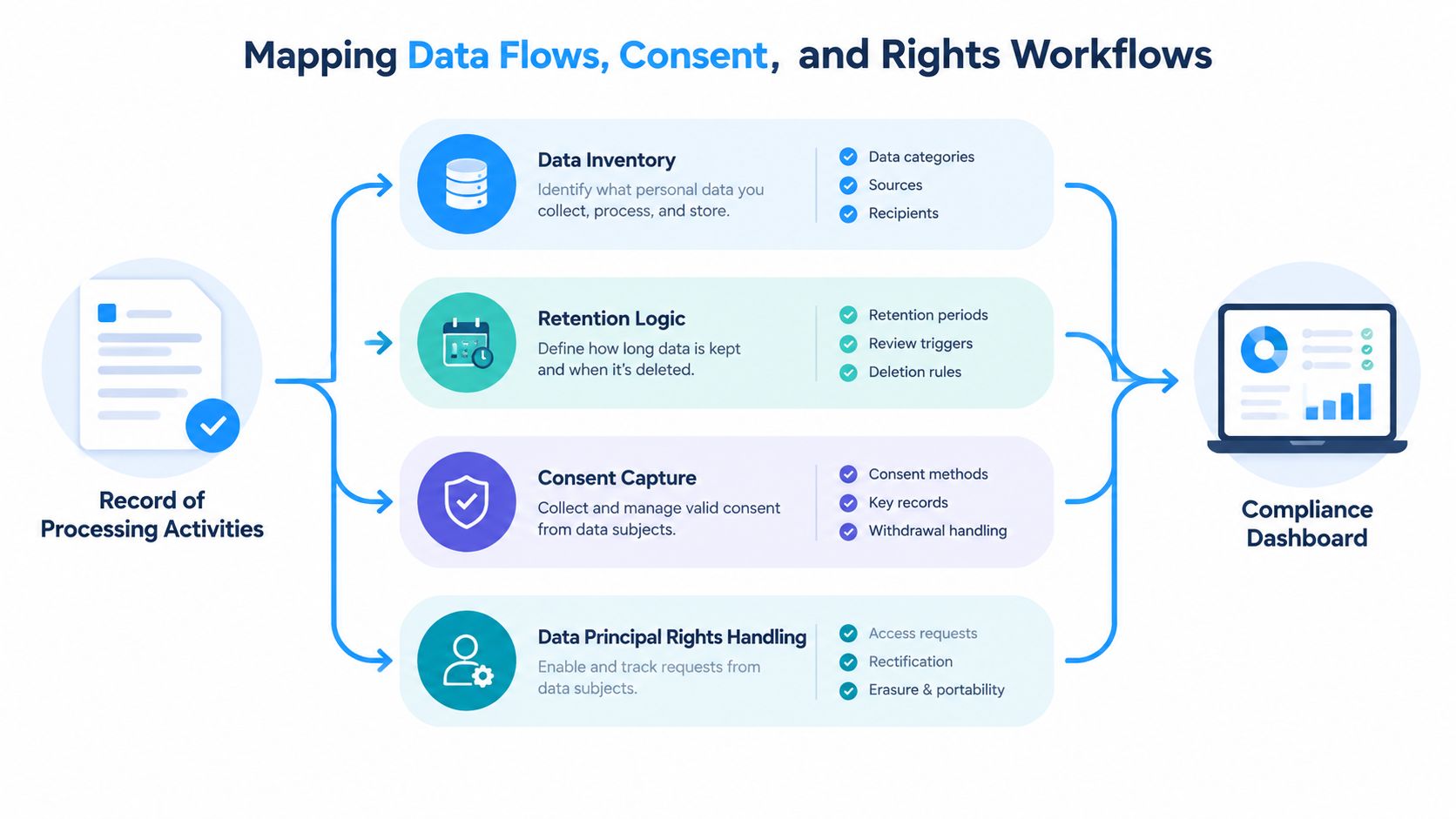
A customer withdraws consent through the app, yet an analytics tool, support platform, and vendor database continue processing the same data. That failure usually starts with disconnected inventories, consent records, retention schedules, and rights queues. Treat them as one engineering and governance backbone, or the company cannot prove what happened across its environment.
Start with a Record of Processing Activities style register. For every processing activity, record the personal-data category, purpose, storage location, recipient, retention period, deletion or anonymisation trigger, and responsible owner.
Capture consent as evidence
A checkbox alone is not a consent system. Preserve the exact notice or consent text displayed, the data principal identifier, timestamp, purpose, collection channel, and every later withdrawal event. Link that receipt to the processing activity and the systems that depend on it.
Test the difficult paths, not only the successful journey. Product teams should test partial consent, withdrawal after data sharing, account closure, consent changes across devices, and vendor synchronisation failures. If the platform cannot show what happened to a consent record, the legal team cannot defend the workflow.
The November 2026 Consent Manager milestone makes this integration work urgent. Companies should identify which consent journeys must connect to a Consent Manager and design the interfaces, records, and ownership model before that dependency becomes a release blocker.
Automate rights handling
Access, correction, erasure, grievance, and nomination requests need defined intake channels and accountable workflows. Build identity verification into intake, start an SLA timer, route requests to system owners, and escalate exceptions when a source system cannot complete the action.
Retention logic must be executable. Each data category needs a lifecycle that states when data is retained, reviewed, deleted, or anonymised. Connect those rules to rights and breach workflows, including notification processes that operate without delay and follow-up reporting within 72 hours.
Where EU representation belongs in the same operating model, an EU GDPR Representative can provide a formal EU-based designation for relevant cross-border operations. Keep the appointment record connected to the processing inventory and communication workflow, rather than treating it as an isolated legal document.
Where DPDP Meets EU and UK Compliance Obligations
An Indian SaaS company can satisfy a DPDP checklist and still fail its European obligations. DPDP does not replace the EU GDPR, the UK GDPR, or the EU AI Act. Companies selling into Europe should build a unified mandate model: shared engineering and governance controls for common requirements, with jurisdiction-specific rules where the regimes diverge.
An Indian company offering services to people in the EU needs an Article 27 representative unless it can confirm that no GDPR territorial trigger applies to its processing. Companies assessing that threshold can use this guide on whether GDPR applies to Indian companies as part of their initial scoping. The same disciplined assessment is required under the UK GDPR for relevant processing involving people in the United Kingdom. AI providers must also assess representative obligations under the EU AI Act alongside their GDPR responsibilities.
Share the operating backbone
A single data inventory can support DPDP records, GDPR records of processing, customer diligence, and transfer assessments. A shared consent receipt can preserve evidence across applicable notice and consent journeys. A common breach escalation tree can route incidents to security, privacy, affected customers, and relevant authorities according to the regime that applies.
The legal bases will not always match. DPDP consent and notice design may not satisfy every GDPR lawful basis. Data Principal rights can differ from EU or UK rights, while children’s data requirements and cross-border transfer conditions require separate analysis. Build one control layer, then configure jurisdiction-specific decision logic instead of maintaining disconnected systems.
| Obligation | DPDP Act | EU GDPR | UK GDPR |
|---|---|---|---|
| Transparency | Clear notices and consent handling for applicable processing | Information duties and transparent processing notices | Equivalent transparency duties under the UK framework |
| Processing justification | Consent and other permitted grounds under DPDP | Multiple lawful bases, including consent, contract, and legitimate interests | Multiple lawful bases under the retained UK GDPR framework |
| Records and governance | Data mapping, accountability, safeguards, and applicable fiduciary duties | ROPA, accountability, DPIAs where required, and governance controls | ROPA, accountability, DPIAs where required, and governance controls |
| Rights operations | Data Principal rights workflows for applicable requests | Access, rectification, erasure, restriction, objection, and related rights | Comparable rights with UK-specific regulatory administration |
| International transfers | DPDP cross-border transfer rules and government restrictions | Transfer mechanisms and safeguards, including SCC arrangements where relevant | UK transfer mechanisms and safeguards, including UK-specific arrangements |
| Representation | Depends on the organisation’s DPDP role and applicable requirements | Article 27 representative assessment for relevant non-EU organisations | UK representative assessment for relevant non-UK organisations |
For a company without an in-market presence, an EU regulatory representative service can form part of its cross-border governance model. It does not transfer compliance ownership. The company still needs an accurate inventory, enforceable contracts, documented decisions, and evidence showing how each obligation is handled. Representation should connect to those operating records, not sit in a separate legal file.
Breach Response and Evidence Retention as a Measurable Posture
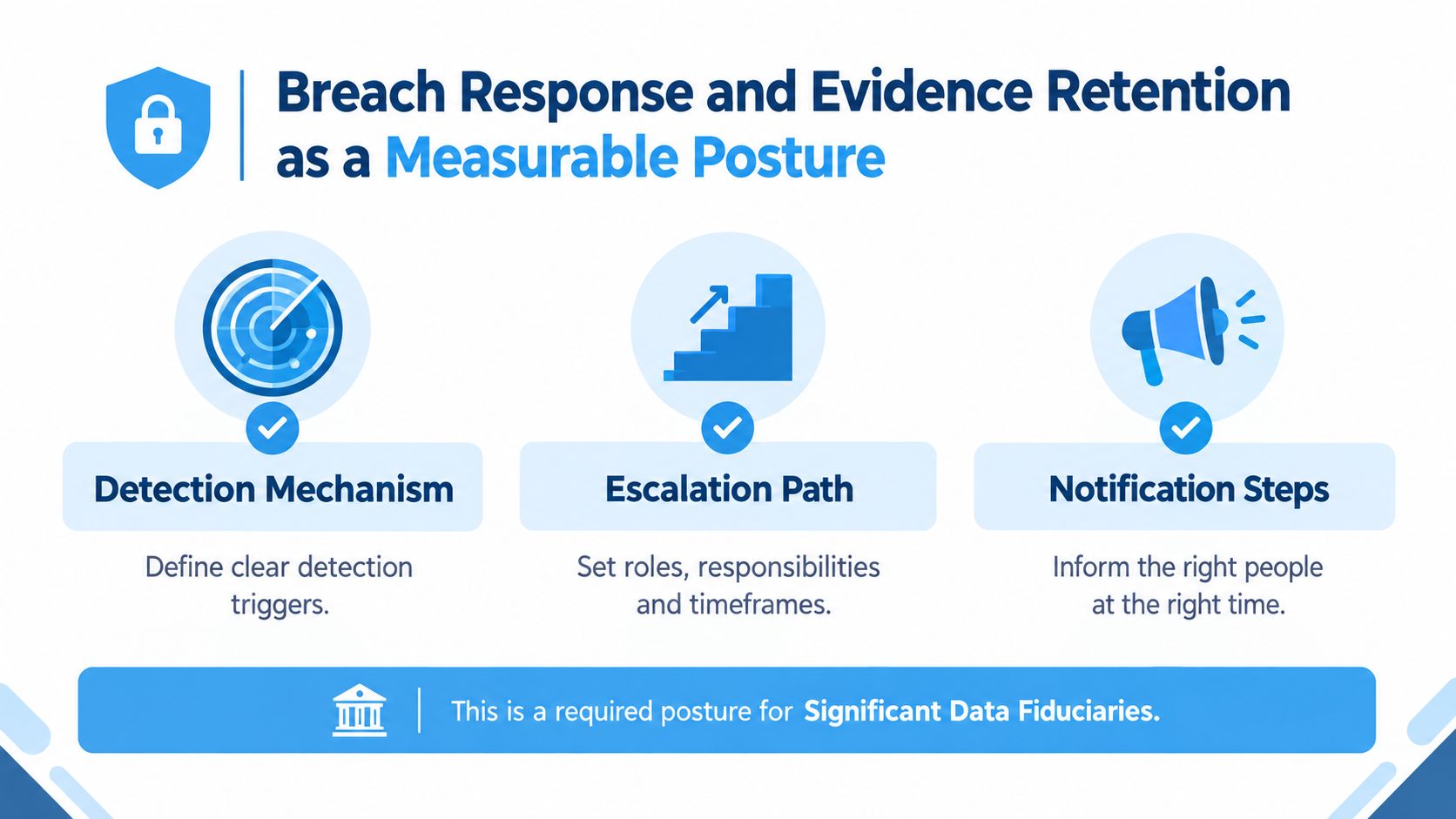
A breach response plan shouldn’t live in a PDF that nobody has rehearsed. Under the DPDP implementation guidance, breach intimation to the Data Protection Board requires an initial notice without delay, followed by a detailed report within 72 hours. That makes detection, classification, escalation, and evidence preservation part of the compliance posture.
Your incident process should identify the moment the organisation becomes aware of a potential significant breach. The clock shouldn’t depend on finishing the root-cause analysis. Establish an incident commander, define who can classify an event, prepare notification templates, and document how affected Data Principals and the Board will be contacted.
Preserve the reconstruction trail
Forensic logs, access records, alerts, tickets, decisions, communications, and system artefacts should move into tamper-evident storage. Define legal holds for relevant evidence and prevent routine deletion from destroying the timeline needed for a Board inquiry, customer question, or Data Principal claim.
Measure the process with operational indicators:
- Detection: How quickly does the team identify a suspected incident?
- Containment: How quickly can the incident commander limit further exposure?
- Triage: Are incidents classified within the organisation’s target window?
- Notification: Can the team prepare and approve the required notices without avoidable delay?
- Exercise quality: Do tabletop exercises expose unclear owners, missing logs, or vendor escalation gaps?
A mature incident programme proves what happened, when it happened, who decided what, and which controls were activated.
Indian companies serving European customers should also connect this process to their customer and regulator communication model. Teams reviewing contract terms and escalation duties can also consider this guide on avoiding the 72-hour breach trap in data processing agreements. Where relevant, EU GDPR compliance services can sit alongside internal incident governance, but no external service can compensate for missing logs or an untested escalation tree.
A 12-Month Readiness Scenario for a Growing Indian Company
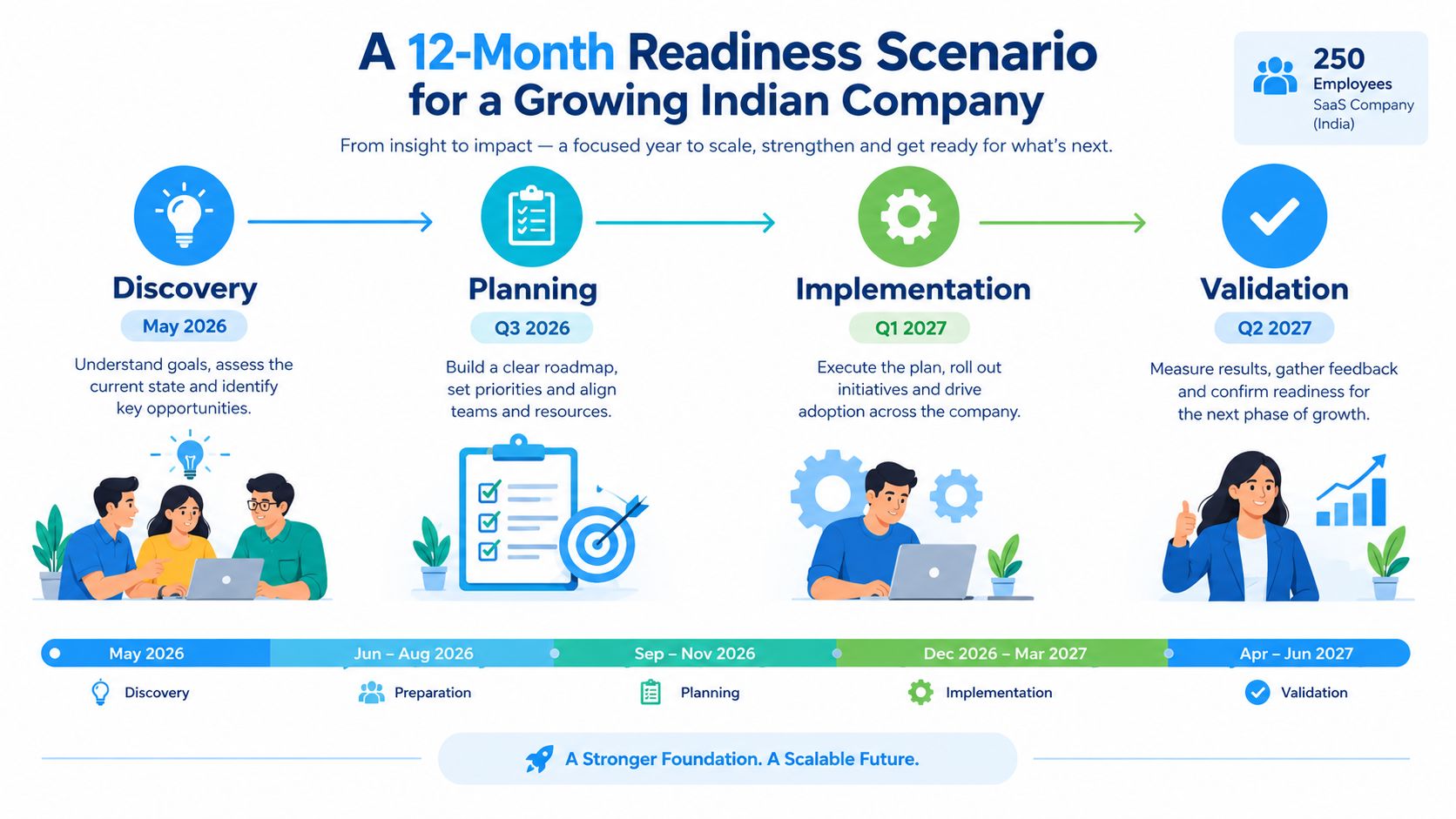
Consider a fictional Indian SaaS company with 250 employees, serving customers in India, the EU, and the UK. In May 2026, the founder learns that the Consent Manager milestone arrives before the final enforcement date. The company has a privacy lead, a security team, and product engineers, but consent records are split between application databases, a customer support platform, and marketing tools.
The founder reallocates two engineers and the privacy lead from feature work. That decision creates commercial pressure, but postponing the work would leave the company trying to redesign consent, retention, vendor contracts, and incident evidence at the same time.
Sequence the work by dependency
By July, the company completes its data-flow inventory and discovers that a sales integration sends account information to a vendor not listed in the original privacy documentation. By August, it rewrites retention rules and maps deletion triggers to customer closure, contract expiry, and support records.
In September, the team admits it underinvested in consent logging. The product can collect consent, but it can’t reliably preserve the version of the notice shown or propagate withdrawal to every downstream tool. Engineers fix the receipt model before rebuilding the user interface.
October is reserved for breach drills. The exercise reveals that the on-call security engineer can detect an event but doesn’t know who owns Board communication. The company assigns an incident commander and creates an escalation path that includes legal, security, customer success, and relevant vendors.
Use the early months of 2027 for integration
In January, procurement updates processor agreements and cross-border transfer documentation for EU and UK customer operations. The privacy lead then tests rights automation across the application, support platform, backup environment, and key vendors.
By April, the company runs a DPB notification dry-run, reviews evidence with the board, and records unresolved exceptions. Its strongest improvement isn’t a polished policy. It is the automated rights workflow, which gives the privacy team a traceable request history and gives system owners clear tasks.
This scenario exposes the trade-off: feature capacity is finite, but compliance dependencies are not optional. Allocate people according to the systems that create the greatest evidence and remediation risk, then test the result before the final gate.
A Practical 90-Day Readiness Checklist Before May 2027
The final 90 days should be a controlled validation period, not a rescue mission. Use the schedule below only after the foundational work is substantially complete. If core data mapping or consent architecture is still missing, escalate that immediately to the executive team because the remaining time is for integration, testing, and evidence closure.
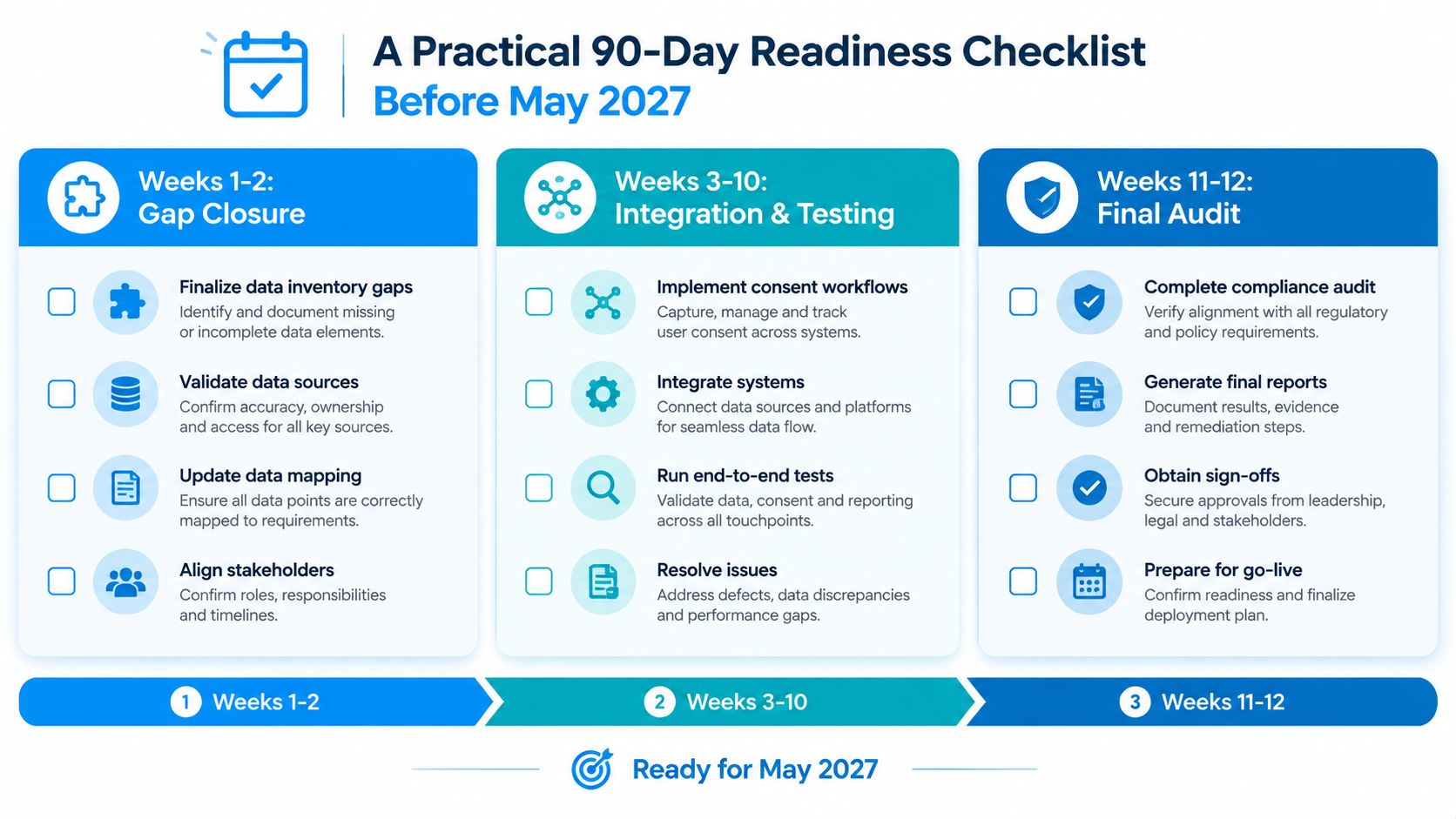
Weeks one and two, close known gaps
- Inventory completion: Resolve unidentified systems, vendors, recipients, storage locations, and processing purposes.
- Consent architecture: Confirm whether the product relies on a registered Consent Manager and test capture, withdrawal, and receipt retrieval.
- Retention control: Lock schedules, deletion triggers, anonymisation rules, and exception approvals.
- Ownership: Assign a named owner to every open remediation item and set an escalation route for blocked work.
Weeks three to six, integrate the operating model
Update processing agreements and supplier schedules. Confirm the cross-border transfer mechanism and the communication responsibilities for EU and UK operations. Rehearse the breach notification scripts, including the initial notice and the detailed follow-up process.
At this stage, don’t accept screenshots as the only proof. Link each document to a system, processing activity, vendor, or decision record.
Weeks seven to ten, capture evidence
- Access reviews: Export role and privileged-access evidence, record exceptions, and close stale permissions.
- Security attestations: Preserve encryption, backup, monitoring, vulnerability, and incident-response evidence.
- Consent audit trail: Confirm that production systems log consent events with the required context.
- Rights testing: Run access, correction, erasure, grievance, and nomination scenarios through the full workflow.
- Vendor validation: Check that suppliers can provide records and escalate incidents through the agreed channel.
Weeks eleven and twelve, rehearse and sign off
Run a tabletop exercise, complete a DPB submission dry-run, and ask the board or executive committee to sign off on readiness and accepted exceptions. Track median rights-request turnaround, breach-drill completion time, the percentage of systems logging consent events, unresolved high-risk findings, and evidence availability by control.
The final decision should be evidence-led. If leadership can’t see the control owner, test result, exception status, and supporting artefact, the programme isn’t ready for sign-off.
DilicheckRep provides formal EU and UK regulatory representation for organisations operating internationally, including structured handling of regulatory communications and mandate documentation. If your DPDP readiness programme must also support European operations, visit DilicheckRep to assess how its representation infrastructure fits your governance model.
Disclaimer: This guide is provided for general information purposes only and does not constitute legal advice. The application of EU data protection and other regulatory requirements depends on the specific circumstances of each organisation. You should obtain appropriate legal advice where necessary before relying on this information or making compliance decisions.
AI notice: This article was prepared by an expert with AI assistance.